Orthogonal polynomials, rotation matrices, angular momentum algebra, etc. More...
Functions/Subroutines | |
| subroutine | tic (this) |
| subroutine | toc (this) |
| integer function | binomial (n, k) |
| recursive real(kind=idp) function | jacobi (n, a, b, x) |
| Calculate the Jacobi polynomials using recurrence relations. | |
| recursive real(idp) function | flm (l, m) |
| subroutine | a_legendre_p (lmax, beta, plm) |
| subroutine | a_sp_harm (lmax, theta, phi, ylm) |
| subroutine | a_re_sp_harm (lmax, theta, phi, ylm) |
| subroutine | grid_theta_phi (steps, arange, theta_grid, phi_grid) |
| subroutine | grid_sp_harm (lmax, steps, arange, ylm_grid, basis_type) |
| subroutine | grid_wigner_D (lmax, steps, arange, d_grid, basis_type) |
| real(kind=kind(1.d0)) function | wigner_small_d (beta, j, m, n) |
| Compute the value of the Wigner d matrix. | |
| complex(kind=idp) function | wigner_d (alpha, beta, gamma, j, m, n) |
| Calculate the wigner D function. | |
| real(idp) function | re_wigner_d (alpha, beta, gamma, j, m, n) |
| real(idp) function | azim_fn (theta, m) |
| subroutine | a_wigner_d (jmax, alpha, beta, gamma, djmn) |
| subroutine | a_re_wigner_d (jmax, alpha, beta, gamma, djmn) |
| complex(kind=idp) function | sp_harm (j, m, theta, phi) |
| Calculate spherical harmonic using wigner small d. | |
| real(kind=idp) function | re_sp_harm (j, m, theta, phi) |
| complex(rk) function | sph_basis_transform_elm (l, m, mp, basis_type) |
| subroutine | sph_basis_transform_matrix (u, lmax, basis_type) |
| integer function | lm2i (l, m) |
| subroutine | i2lm (i, l, m) |
| recursive real(rk) function | binom (n, r) |
| real(rk) function | cleb (j1, m1, j2, m2, j, m) |
| real(rk) function | threej (j1, m1, j2, m2, j, m) |
| function | cphaz (l, eta, iwrite) |
| subroutine | linspace (from, to, no_steps, array, include_end_point) |
Variables | |
| integer, parameter | rk = idp |
Detailed Description
Orthogonal polynomials, rotation matrices, angular momentum algebra, etc.
- Date
- 2019
Contains:
- Spherical harmonics, Legendre polynomials and associated functions.
- Wigner 3j and Clebsch-Gordan coefficients
- Wigner D matrices (real and complex forms)
- Coulomb phase function.
- Various indexing functions and other misc. functions.
Function/Subroutine Documentation
◆ a_legendre_p()
| subroutine dipelm_special_functions::a_legendre_p | ( | integer | lmax, |
| real(idp) | beta, | ||
| real(idp), dimension(:), allocatable | plm ) |

◆ a_re_sp_harm()
| subroutine dipelm_special_functions::a_re_sp_harm | ( | integer | lmax, |
| real(idp) | theta, | ||
| real(idp) | phi, | ||
| complex(idp), dimension(:), allocatable | ylm ) |

◆ a_re_wigner_d()
| subroutine dipelm_special_functions::a_re_wigner_d | ( | integer, intent(in) | jmax, |
| real(idp), intent(in) | alpha, | ||
| real(idp), intent(in) | beta, | ||
| real(idp), intent(in) | gamma, | ||
| complex(idp), dimension(:,:), intent(inout), allocatable | djmn ) |

◆ a_sp_harm()
| subroutine dipelm_special_functions::a_sp_harm | ( | integer | lmax, |
| real(idp) | theta, | ||
| real(idp) | phi, | ||
| complex(idp), dimension(:), allocatable | ylm ) |

◆ a_wigner_d()
| subroutine dipelm_special_functions::a_wigner_d | ( | integer, intent(in) | jmax, |
| real(kind=idp), intent(in) | alpha, | ||
| real(kind=idp), intent(in) | beta, | ||
| real(kind=idp), intent(in) | gamma, | ||
| complex(kind=idp), dimension(:,:), intent(inout), allocatable | djmn ) |

◆ azim_fn()
| real(idp) function dipelm_special_functions::azim_fn | ( | real(kind=idp), intent(in) | theta, |
| integer, intent(in) | m ) |

◆ binom()
| recursive real(rk) function dipelm_special_functions::binom | ( | integer | n, |
| integer | r ) |

◆ binomial()
| integer function dipelm_special_functions::binomial | ( | integer, intent(in) | n, |
| integer, intent(in) | k ) |

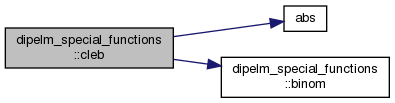
◆ cleb()
| real(rk) function dipelm_special_functions::cleb | ( | integer | j1, |
| integer | m1, | ||
| integer | j2, | ||
| integer | m2, | ||
| integer | j, | ||
| integer | m ) |
◆ cphaz()
| function dipelm_special_functions::cphaz | ( | l, | |
| eta, | |||
| iwrite ) |

◆ flm()
| recursive real(idp) function dipelm_special_functions::flm | ( | integer | l, |
| integer | m ) |

◆ grid_sp_harm()
| subroutine dipelm_special_functions::grid_sp_harm | ( | integer | lmax, |
| integer, dimension(:) | steps, | ||
| real(idp), dimension(:) | arange, | ||
| complex(idp), dimension(:,:), allocatable | ylm_grid, | ||
| character(len=3) | basis_type ) |

◆ grid_theta_phi()
| subroutine dipelm_special_functions::grid_theta_phi | ( | integer, dimension(:) | steps, |
| real(idp), dimension(:) | arange, | ||
| real(idp), dimension(:), allocatable | theta_grid, | ||
| real(idp), dimension(:), allocatable | phi_grid ) |
◆ grid_wigner_D()
| subroutine dipelm_special_functions::grid_wigner_D | ( | integer | lmax, |
| integer, dimension(:) | steps, | ||
| real(idp), dimension(:) | arange, | ||
| complex(idp), dimension(:,:,:), allocatable | d_grid, | ||
| character(len=3) | basis_type ) |

◆ i2lm()
| subroutine dipelm_special_functions::i2lm | ( | integer | i, |
| integer | l, | ||
| integer | m ) |
◆ jacobi()
| recursive real(kind=idp) function dipelm_special_functions::jacobi | ( | integer, intent(in) | n, |
| integer, intent(in) | a, | ||
| integer, intent(in) | b, | ||
| real(kind=idp), intent(in) | x ) |
Calculate the Jacobi polynomials using recurrence relations.
\begin{align} P^{(a,b)}_0(x) &= 1 \\ P^{(a,b)}_1(x) &= \frac{(2+a+b)x+(a-b)}{2} \\ P^{(a,b)}_n(x) &= (2n+a+b-1)((a^2-b^2) + (2n+a+b)(2n+a+b-2)x)P^{(a,b)}_{n-1}(x) - \frac{2(n-1+a)(n-1+b)(2n+a+b))}{(2n(n+a+b)(2n-2+a+b))}P^{(a,b)}_{n-2}(x) \end{align}

◆ linspace()
| subroutine dipelm_special_functions::linspace | ( | real(idp), intent(in) | from, |
| real(idp), intent(in) | to, | ||
| integer | no_steps, | ||
| real(idp), dimension(:), allocatable | array, | ||
| logical, optional | include_end_point ) |
◆ lm2i()
| integer function dipelm_special_functions::lm2i | ( | integer | l, |
| integer | m ) |

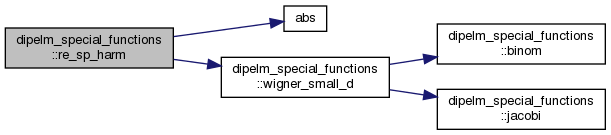
◆ re_sp_harm()
| real(kind=idp) function dipelm_special_functions::re_sp_harm | ( | integer, intent(in) | j, |
| integer, intent(in) | m, | ||
| real(kind=idp), intent(in) | theta, | ||
| real(kind=idp), intent(in) | phi ) |
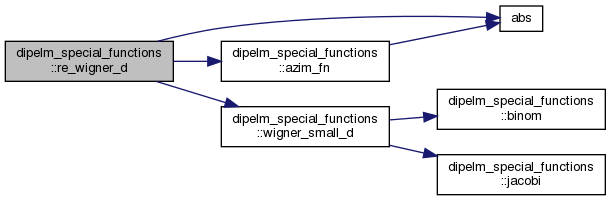
◆ re_wigner_d()
| real(idp) function dipelm_special_functions::re_wigner_d | ( | real(idp), intent(in) | alpha, |
| real(idp), intent(in) | beta, | ||
| real(idp), intent(in) | gamma, | ||
| integer, intent(in) | j, | ||
| integer, intent(in) | m, | ||
| integer, intent(in) | n ) |
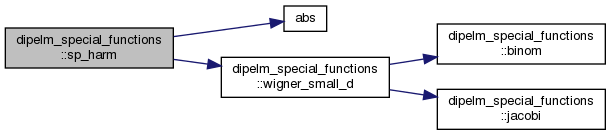
◆ sp_harm()
| complex(kind=idp) function dipelm_special_functions::sp_harm | ( | integer, intent(in) | j, |
| integer, intent(in) | m, | ||
| real(kind=idp), intent(in) | theta, | ||
| real(kind=idp), intent(in) | phi ) |
Calculate spherical harmonic using wigner small d.
The relation used is:
\begin{align} Y_{jm}(\theta, \phi) &= \sqrt\frac{2j+1}{4\pi}d^j_{|m|0}(\theta) e^{im\phi} \qquad m \geq 0 \\ &= (-1)^m \sqrt\frac{2j+1}{4\pi}d^j_{|m|0}(\theta) e^{im\phi} \qquad m < 0 \\ \end{align}
◆ sph_basis_transform_elm()
| complex(rk) function dipelm_special_functions::sph_basis_transform_elm | ( | integer, intent(in) | l, |
| integer, intent(in) | m, | ||
| integer, intent(in) | mp, | ||
| character(3) | basis_type ) |

◆ sph_basis_transform_matrix()
| subroutine dipelm_special_functions::sph_basis_transform_matrix | ( | complex(rk), dimension(:,:), intent(inout), allocatable | u, |
| integer, intent(in) | lmax, | ||
| character(3) | basis_type ) |

◆ threej()
| real(rk) function dipelm_special_functions::threej | ( | integer | j1, |
| integer | m1, | ||
| integer | j2, | ||
| integer | m2, | ||
| integer | j, | ||
| integer | m ) |

◆ tic()
| subroutine dipelm_special_functions::tic | ( | class(time) | this | ) |
◆ toc()
| subroutine dipelm_special_functions::toc | ( | class(time) | this | ) |
◆ wigner_d()
| complex(kind=idp) function dipelm_special_functions::wigner_d | ( | real(kind=idp), intent(in) | alpha, |
| real(kind=idp), intent(in) | beta, | ||
| real(kind=idp), intent(in) | gamma, | ||
| integer, intent(in) | j, | ||
| integer, intent(in) | m, | ||
| integer, intent(in) | n ) |
Calculate the wigner D function.
Rotation matrix elements for the complex spherical harmonics. They have the form:

◆ wigner_small_d()
| real(kind=kind(1.d0)) function dipelm_special_functions::wigner_small_d | ( | real(kind=idp), intent(in) | beta, |
| integer, intent(in) | j, | ||
| integer, intent(in) | m, | ||
| integer, intent(in) | n ) |
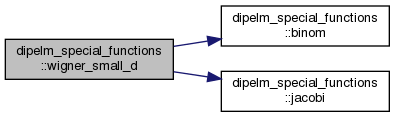
Compute the value of the Wigner d matrix.
The explicit expression involving Jacobi Polynomials is used:
\[ d^{j}_{mn}(\beta)=(-1)^{\lambda} \binom{2j-k}{k+a}^{\frac{1}{2}} \binom{k+b}{b}^{-\frac{1}{2}} \left(\sin\frac{\beta}{2}\right)^a \left(\cos\frac{\beta}{2}\right)^b P^{(a,b)}_k(\cos\beta) \]
where \( k = \min(j+n, j-n, j+m, j-m). \)
\( a \) and \( \lambda \) depend on the form of \( k \) and are given by
\[ k = \begin{cases} j+n: & a=m-n;\quad \lambda=m-n\\ j-n: & a=n-m;\quad \lambda= 0 \\ j+m: & a=n-m;\quad \lambda= 0 \\ j-m: & a=m-n;\quad \lambda=m-n \\ \end{cases} \]
and \( b=2j-2k-a \)
- See also
- wigner_d
- Todo
- Implement recurrence relation approach to calculating wigner d
Variable Documentation
◆ rk
| integer, parameter dipelm_special_functions::rk = idp |
